Loading...



At Global Payments, we recently ran a vibe coding challenge (a short sprint where teams build fast with AI coding tools). Teams had a few days to ship working prototypes. The goal was to see what we could build in hours instead of weeks.
We built Shopstack – an AI agent that helps small and mid-sized merchants set up loyalty programs in under two minutes, proving that what usually takes weeks of phone calls, document reviews, and form submissions can now happen in a single conversation.
The first iteration was live in 10 hours shifting our development timeline from months to hours. This is the true power of accelerated development with AI.
For context, we first need to talk about what Shopstack is and isn’t.
Shopstack isn’t just a basic “question-and-answer” chatbot. It’s a Level 2 AI Agent powered by Gemini that functions as a high-speed recommendation engine. It analyzes the unique variables of your business to provide real-time strategic advice – a path to the right decision.
It uses three specialized tools:
When you ask, “Calculate my ROI,” the agent doesn't guess—it calls our ROI calculator with your actual revenue and customer data to perform the calculation, then explains the results in your selected language."
Our AI Agent can create a loyalty program for you based on your business type, the unique challenges you want to solve with it, and any requirements you have for the program you want. We’ve also built in a guided, “human in the loop” flow to ensure that users can review the program setup they’ve chosen and make changes if needed.
Instead of navigating a complex setup flow or calling support, you can now simply describe what you want in plain language, and Shopstack will help you land on the right program.
Shopstack is currently a prototype. Once it's released, you’ll be able to find it inside My Account, where you’ll see a simple prompt: “Ask me anything about loyalty programs. I’m here to help.”
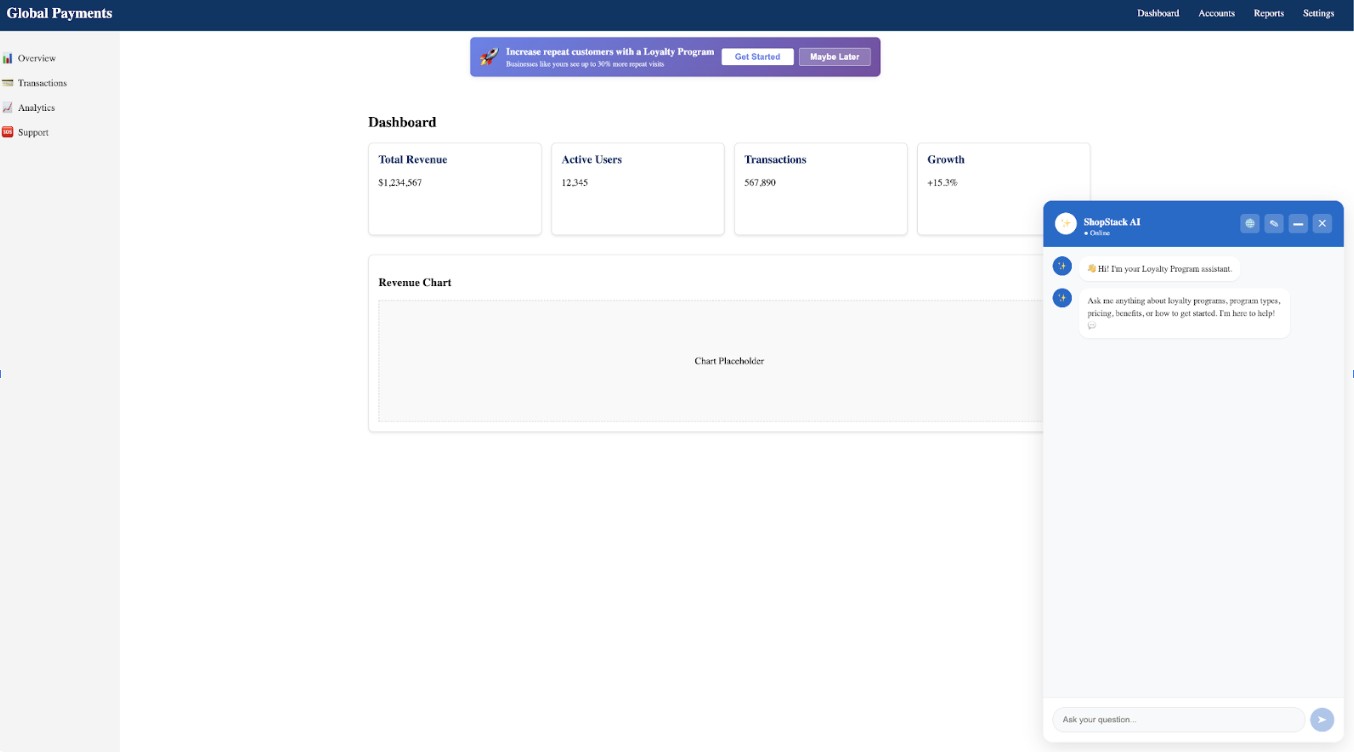
Screenshot of My Account test dashboard with the Shopstack prompt
As you chat with Shopstack, it will get to know your business better and suggest relevant options for you to consider. This will save you a lot of time because Global Payments has a lot of options to choose from, including points-based rewards, tier-based programs, and other loyalty approaches. Instead of wading through all of them to find the best fit, Shopstack will do that for you.
For example, if you run a retail store, Shopstack will recommend only the options that work well for retail businesses, helping you to quickly narrow down the choices. And if you want to understand return on investment (ROI) before you commit, you can estimate projected returns based on your revenue and transaction patterns.
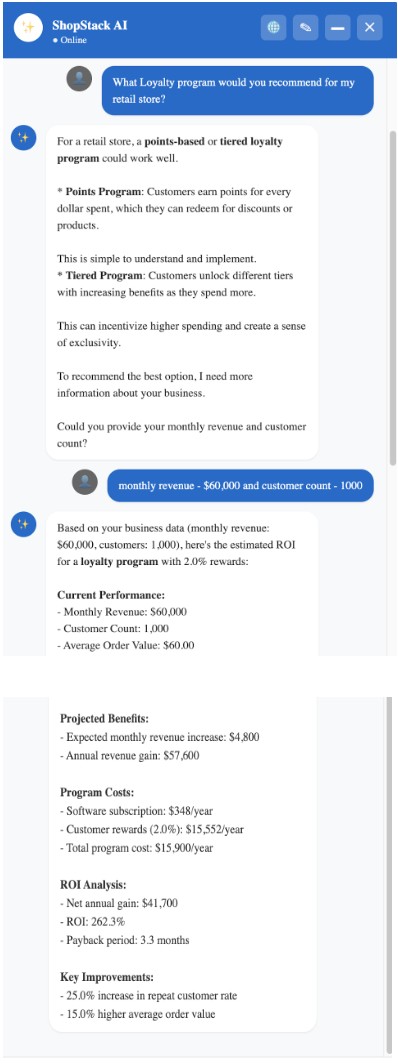
Example of how Shopstack can provide recommendations for retail store owners
Once you choose a program, a guided wizard will walk you through the setup. You’ll first enter your business details, and then select your program. Once you review the details, you just confirm payment. All of this takes just a few minutes.
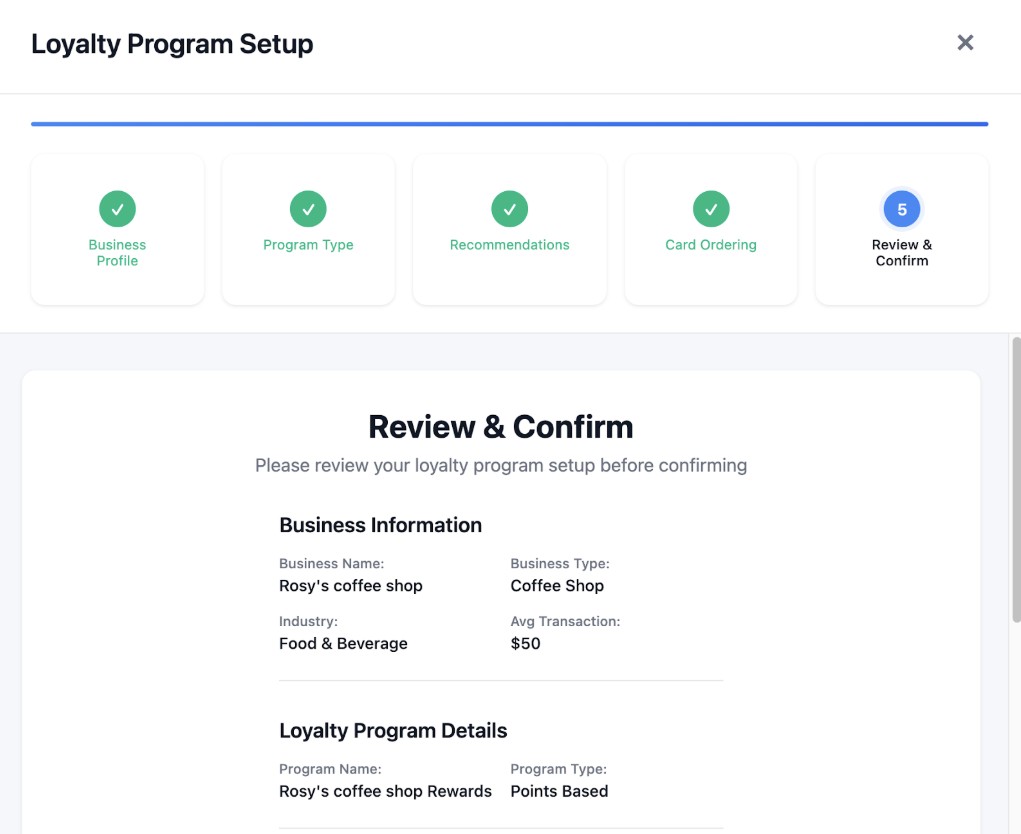
Shopstack guides you through the process to quickly set up your program.
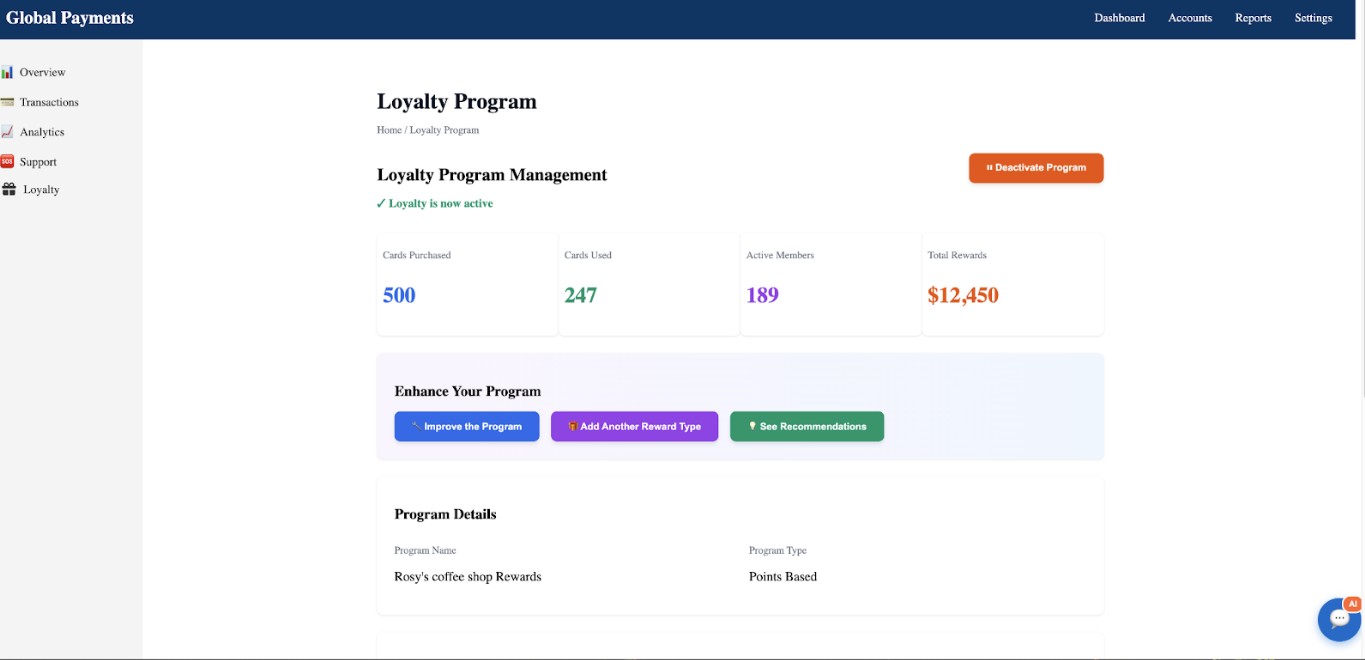
Within minutes, your loyalty program is up and running.
We built Shopstack to serve as the recommendation engine for SMB merchants with the goal of creating a more personalized experience for every merchant.
We started with loyalty programs, but our vision for Shopstack is to extend it to the entire value-added services ecosystem Global Payments offers merchants.
Over time, we’ll be rolling out more AI agents that will be able to recommend and configure other merchant services, such as analytics and insights.
For the challenge, we leveraged GitHub Copilot to transform our high-level vision for Shopstack into functional code.
This is the magic of vibe coding – the shift from having to write every line of code by hand to acting instead as high-level architects providing iterative direction while the AI copilot provided the structural work in real time.
Here are the technologies we used to build Shopstack:
The AI copilot scaffolded nearly the entire system in the first 10 hours. First, it helped generate the core architecture, wire up the APIs, shape the prompts, manage state, and handle errors. Work that normally would have taken several days was completed in minutes.
We were able to develop and test three different agent architectures before landing on the final design. The speed of iteration seemed almost unreal — and it changed the way we build. Now, instead of debating different ideas over the course of multiple meetings, we can explore them almost instantly.
The productivity gain was remarkable, around 30-40% faster than our usual development pace.
If you’ve ever struggled through the friction of building AI agents from scratch, vibe coding feels like working with someone who just gets it. With a copilot who already understands your domain and your goals, instead of getting up to speed, you get to start building at speed.
At first, we were very careful to ensure the AI was producing reliable code. We reviewed every line of generated code. We deliberately accepted changes and made sure we fully understood what each piece did.
About midway through the project, we started to feel pretty confident in what the tool was giving us. It felt reliable, so we stopped verifying every suggestion line by line.
That decision was an expensive one.
During testing, when the agent’s behavior didn’t match expectations, we spent nearly 20 hours debugging code that took just two hours to write.
One of the problems we encountered was that the copilot generated prompts that technically worked but were inefficient. They were using around 200 tokens when 50 would have been enough. Tokens are the basic units large language models (LLMs) use to process (and charge for) text.
As we debugged this and other issues, the copilot kept layering on its own fixes, adding duplicate logic, hardcoded values, and fallback mock responses that didn’t even call the LLM. The system not only became more costly to run (more tokens, higher costs), it also became harder to reason with.
In the end, we spent another 20–30 hours cleaning up and optimizing the code, bringing it back to a maintainable state and a solid prototype.
This experience taught us that, despite the speed at which you can build, working with generative AI to develop code still requires strict engineering discipline – even more, in fact.
Now, we’re sharing our lessons learned to help other teams avoid falling into the same traps.
Building successfully with AI requires a simple but powerful mindset shift. Instead of saying, “Copilot, build this,” you need to say, “Copilot, help me build this.”
Despite the difficulties we encountered when building our Shopstack agent, we still think vibe coding is phenomenal for AI development. But agents add a layer of complexity you can’t ignore. They’re stateful, non-deterministic, and heavily dependent on context. That means you need to understand every line you merge. That two-hour sprint can easily turn into 20 hours of cleanup if you don’t.
Shopstack is currently a proof-of-concept. To bring it to production, we expect about 8–12 weeks of additional work. That includes real API integrations, a database layer, and governance approvals – all the other stuff required to turn a prototype into something reliable.
For merchants, that means a faster and easier setup for loyalty programs is coming to My Account very soon. Instead of spending weeks figuring out which program to use and getting it all set up, you’ll have a quick conversation with an agent who understands your business and will help you get it done in minutes.
For developers, the lesson here is that vibe coding can speed up development by 30–40%, but only if you stay accountable for what ships. Understand every line you accept, because your agent’s behavior in production depends on it. With this in mind, go build amazing agents. Just make sure you know what they’re doing.
Want more insights on developer experience, API design, and agentic commerce? Check out our blog to learn about the key engineering perspectives that support building next-gen solutions like Shopstack.