Loading...


With our Payers solution, you can store customer details such as name, billing address, shipping address, and payment methods. This information can then be used for subsequent actions like transaction processing. We handle the storage of all personal identifiable information (PII) on our system, so you don’t need to worry about keeping payer data secure.
With Payers, you can:
In this section, we present some “real world” examples that can be enabled through our Payers solution. Keep in mind that this section doesn’t cover all use cases.
A merchant who lends products to their customers wants to charge them a penalty if the products aren’t returned. The merchant can initially create a payer to store the customer’s details and make a charge to that payer if they miss the deadline to return the products.
An online marketplace allows their customers to create a profile where they can add multiple payment cards and select a default for their purchases. Payers can be used here to store multiple cards for each payer and define which payment card to be used as a default for subsequent transactions.
A video streaming platform that offers a subscription service and has recurring charges against their customers can use the Payers feature to store their customers details and initiate recurring payments against the payer.
Once you’re set up to use our Payers solution, you can start creating your payers. To store cards for a payer, you can use our Card Storage capability to tokenize payment cards. Tokenized cards can then be stored alongside a payer and used for subsequent transactions.
At a high level, creating a payer works like this:
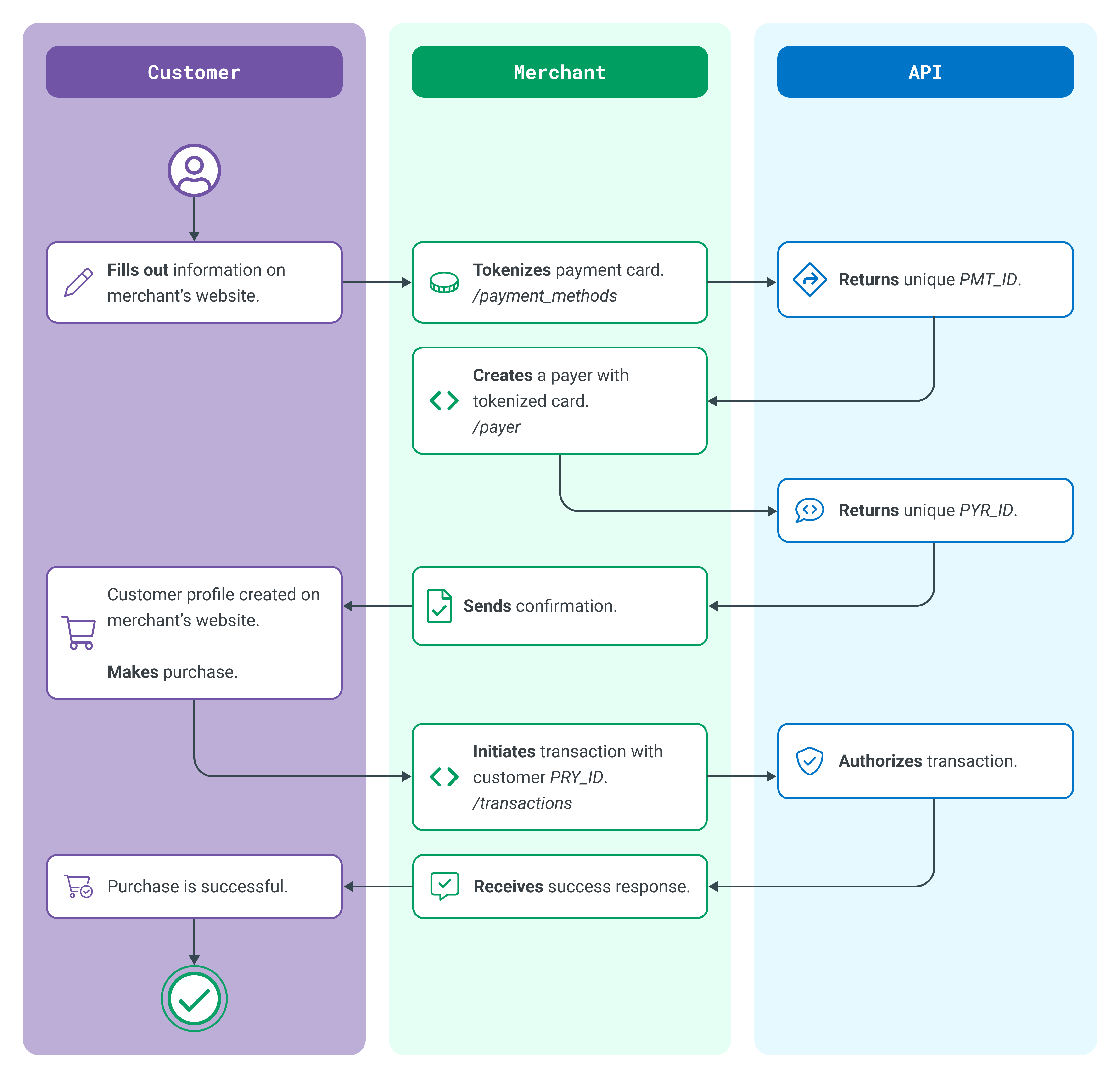
Payers Typical Flow
To get familiar with how Payers work, see our below guide.