Loading...


Every time a customer swipes, taps, or enters card details, they set off a complex interaction across banking systems, APIs, and networks. Understanding this process helps you:
Card transactions are where software meets money – and precision matters.
Card transactions unfold in two distinct — but tightly linked — phases.
The moment a card is used, a real-time check occurs to confirm:
These checks will result in either the transaction being approved or declined within 1-2 seconds.
If approved, the merchant groups the transaction with others and submits them to their processor or acquirer. Funds are then:
Funds are typically available to the merchant within 1-3 business days (or faster with real-time options).
The table below describes the core roles in a card transaction, which often includes a payment processor and payment gateway.
Two of the most complex aspects a card payment system are:
Payment gateways and processors are technology partners that can make these parts of the process easier. While not strictly required for a card transaction, they play an important role in the authentication and settlement processes.
| Role | Function |
|---|---|
| Cardholder | Uses a credit or debit card to initiate a transaction. |
| Merchant | Sells goods/services to a cardholder and submits the transaction data for authorization through a payment gateway. |
| Gateway | Software and servers that securely transmit cardholder data from the merchant’s website, mobile app, or POS system to the payment processor or acquirer, and transmits responses from issuers for authorization. |
| Processor | A company that helps a merchant process card payments by providing the technology to route payment data between the merchant, acquirer, and card networks. |
| Issuer | A financial institution that issues payment cards to cardholders, approves or declines transactions, issues payment to the acquirer on behalf of the cardholder, and bills the cardholder. |
| Acquirer | A financial institution that manages the merchant’s account, processing card payments for the merchant and sending the transactions to the card network. |
| Card Network | A card brand (Mastercard, Visa, etc.) that provides the global financial infrastructure for routing transactions between the acquirer and issuer, sets operational rules, and manages settlement and interchange fees. |
| Step | Description |
|---|---|
| 1 | The cardholder initiates a payment at the point of sale (POS) or through an online checkout process. |
| 2 | The merchant sends the transaction data (card information and amount) to the acquirer either directly or through a payment processor, who will use a payment gateway to send the transaction data to the acquirer. |
| 3 | The acquirer requests authorization from the issuer. |
| 4 | The issuer sends the authorization response (approved or declined) to the acquirer. |
| 5 | The acquirer sends the authorization response to the merchant either directly or back through the payment gateway and payment processor if the merchant is using those services. |
| 6 | Assuming the transaction is approved, the merchant finalizes the sale. |
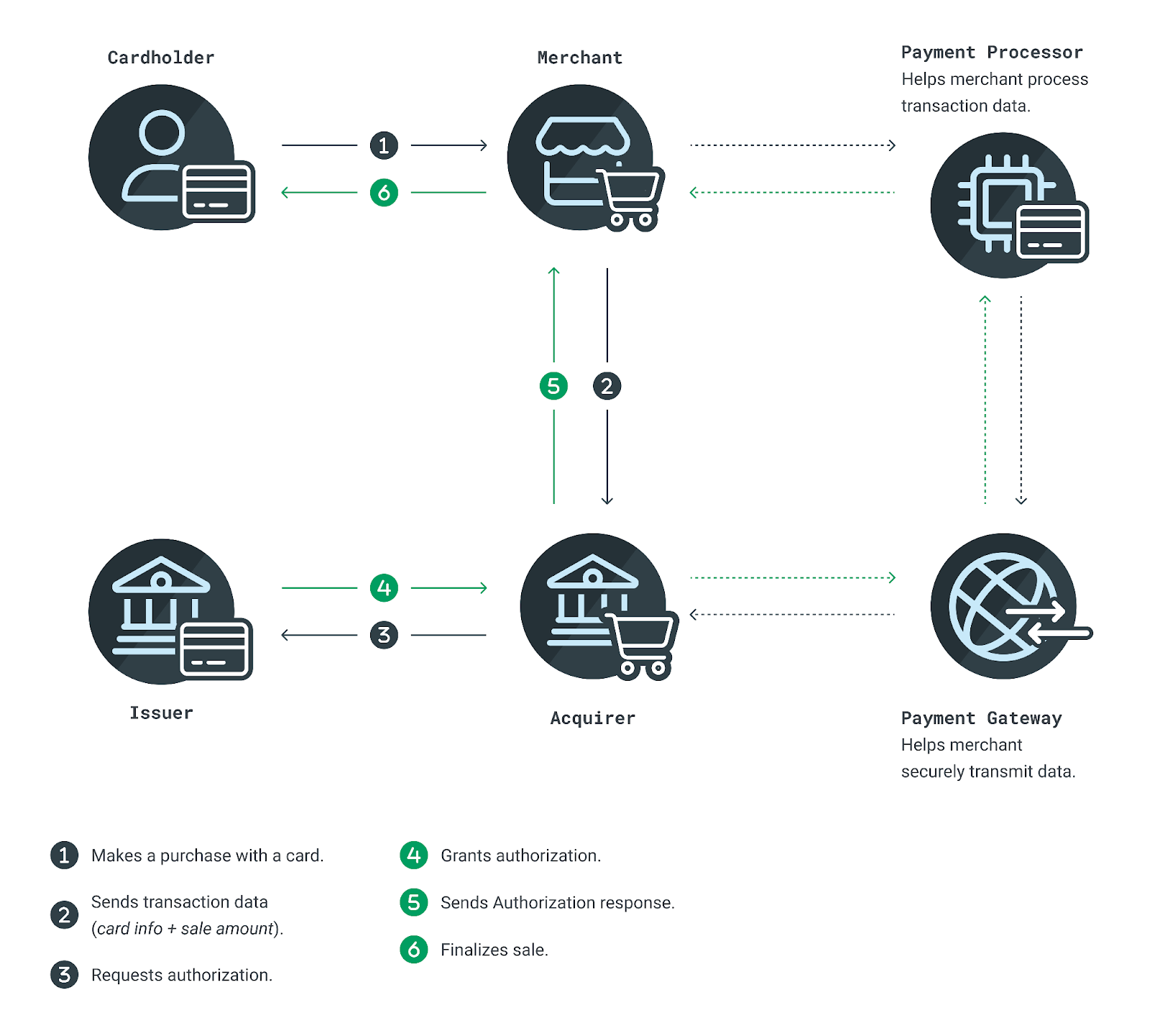
Authorization flow
| Step | Description |
|---|---|
| 1 | The merchant sends captured transactions in batches to the acquirer at the end of the day. |
| 2 | The acquirer clears the transactions (works with the card network and issuer to verify and agree on what’s owed) and then sends the batch file to the card network (aka the card brand). |
| 3 | The card network forwards the transactions to the issuers, who debit/credit each cardholder’s account for the amount of the transactions. |
| 4 | The card network then transfers funds to the acquirers for the sales and credit transactions. |
| 5 | The acquirer deposits funds into the merchant’s account, minus any fees either directly or via the payment gateway and payment processor if the merchant is using those services. |
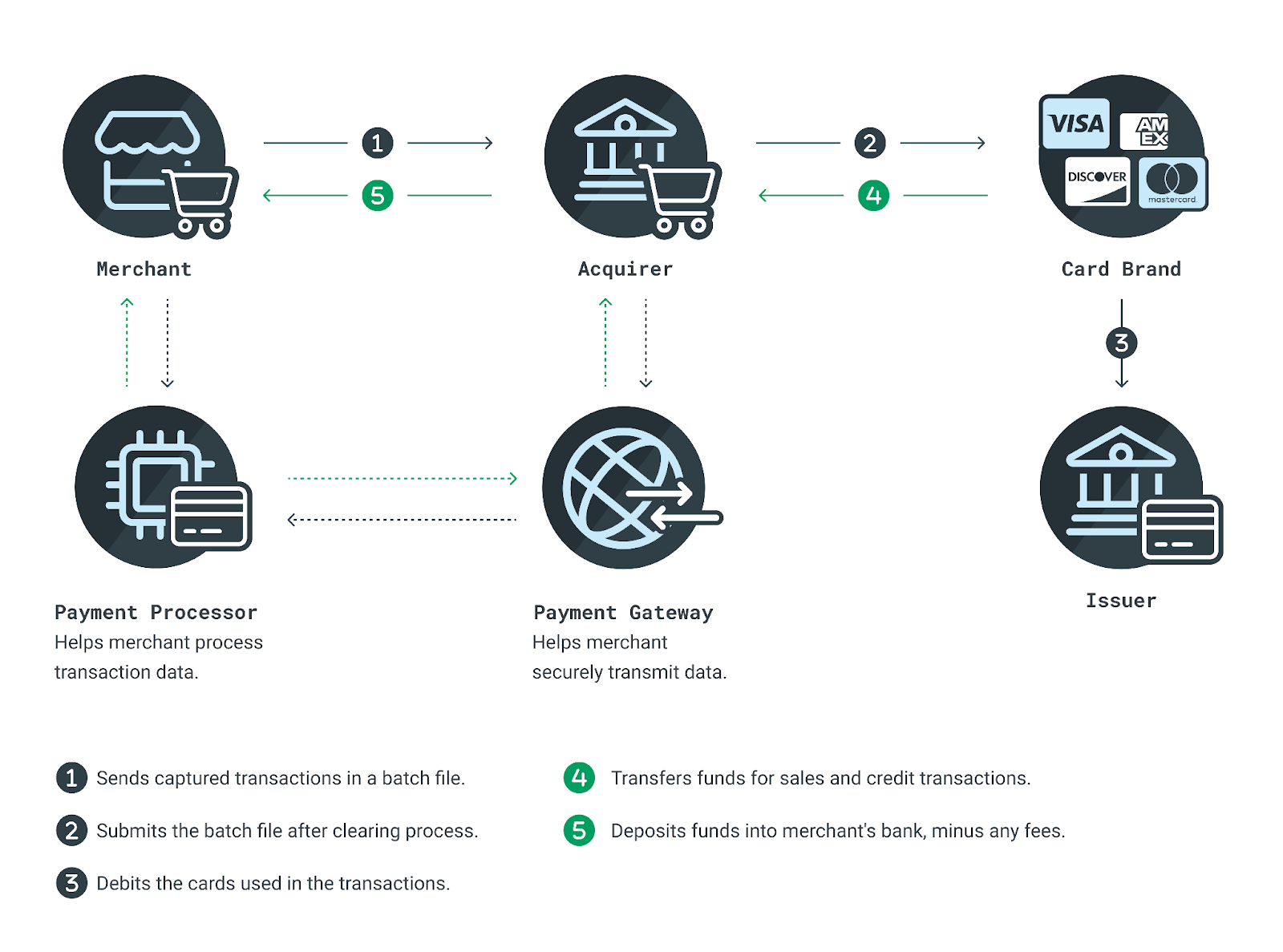
Settlement flow
The following capabilities are critical to ensuring your system is secure and compliant:
| Metric | Why It Matters | Target Benchmark |
|---|---|---|
| Authorization Rate | Measures approval success | 97–99% |
| False Decline Rate | Indicates friction from risk rules | Less than 0.5% |
| Time to Settle | Impacts cash flow | 1–2 business days (avg) |
| Chargeback Rate | Indicates disputes/fraud | Less than 0.9% (Visa/MC threshold) |
| Latency | Affects user experience | Less than 2 seconds |
In the future, card transaction flows will be more:
These shifts are making payments programmable, composable, and highly developer-centric.
Card payments may feel simple to end users — but they represent one of the most high-volume, multi-actor workflows in global commerce.
Building a successful payment system requires that developers, product owners, and merchants:
Next, we’ll explore who actually makes the payments ecosystem work—introducing the players behind each transaction, including card networks, processors, gateways, and platforms like yours.