Loading...


If you’re new to the payments industry, it’s good to start with a basic understanding of how the process for card payments works. You can get that here.
This article will introduce you to the relevant players in the payments industry and walk you through two typical flows: payment and settlement. We also describe how we fit into the process and what solutions we offer to help merchants succeed.
What we cover:
All bolded terms in this article are further defined in our Payments Glossary.
To understand the card payment process, you first need to know who the relevant players are.
 | Card Brands Card associations like Visa or Mastercard that operates a network. |  | Issuer Financial institution that issues cards to customers to use for payments. |
 | Acquirer Financial institution that allows merchants to process card transactions on a card brand’s behalf. |  | Merchant Seller of goods or services. Can be an individual, a business, or a large enterprise. |
 | Cardholder Customer who is issued a payment card to use for purchases. |
Before card payments can begin, the key players need to establish business relationships with each other:
So, when it comes to accepting card payments on behalf of the card brands:
The following illustration shows the business relationship between the key players.
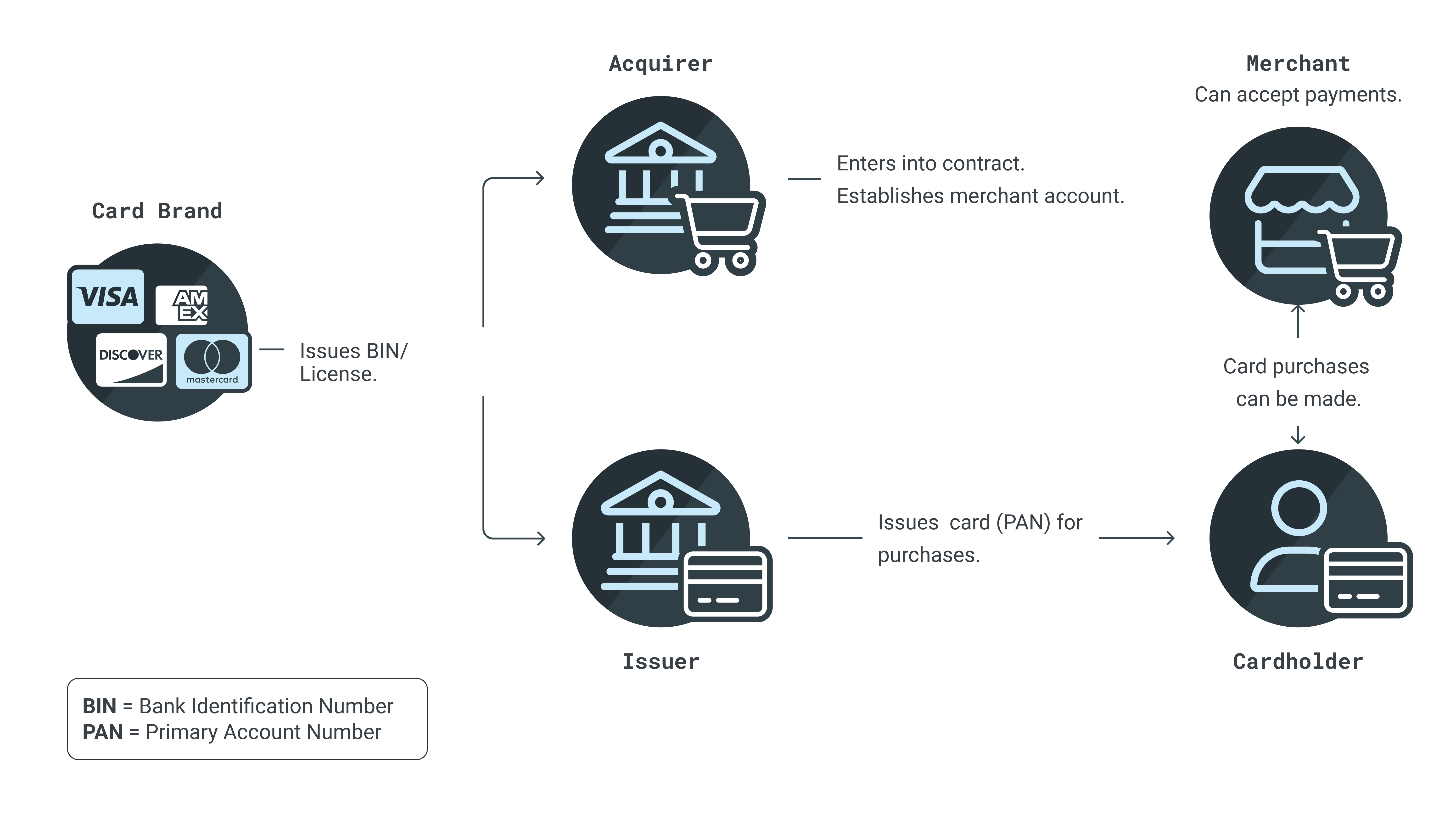
Key Players for Card Payments
Once all the key players have established business relationships with each other, card payments can begin. But with the technical complexity inherent in processing card payments, not to mention all the regulations a merchant must comply with, building a card payment system from the ground up can be a pretty heavy lift. That's why many merchants turn to technology partners.
Two of the most complex aspects of building a card payment system are:
There are three types of technology partners that can make these processes easier – payment gateways, developers that know how to work with them, and payment processors.
A payment gateway is a technology service used to facilitate the secure transmission of transaction data. Using payment gateways simplifies the process of sending payments between a merchant and an acquirer. To interface with the acquirer, developers use an application program interface (API) or software development kit (SDK) to build a software solution or integration that the merchant can use to handle card payments.
Likewise, processing card payments — including having to facilitate authentication (identity checks), authorization (approvals), and clearing (transferring funds) — can also be too much for a merchant to handle. So, it’s common to enlist the support services of a payment processor to help for a fee.
So where does Global Payments fit into this picture? We offer a full range of merchant solutions, including a payment gateway, payment processing, and serving as an acquirer. Our technologies also support developers with a REST API, SDKs, and a developer portal that provides all the resources they need to get up and running quickly.
Learn more about how our solutions can help merchants and developers at the end of this page.
Technology partners that can support a merchant include the following:
 | Payment Gateway Technology service used by a merchant to securely transmit transaction data to the acquirer. |  | Payment Processor Company used by a merchant to help with tasks related to card payment processing. |
 | Developer Person with coding experience hired to develop a software solution for accepting or processing payments. |
In this section, we describe the interaction between the key players and their technology partners in a successful card payment flow. The flow starts when a cardholder selects an item or service to buy from the merchant either in a store or online and pays with a card. Once receiving the card information (PAN + expiry + CVV), the merchant initiates the sale and sends the transaction data (card information + sale amount) to the acquirer either directly or via a payment gateway. For online sales, the cardholder’s identity may need to be authenticated first, such as through 3D Secure.
The acquirer uses the customer’s PAN, which includes the BIN, to identify which card brand to send the transaction data to for approval. The card brand then sends the transaction to the issuer. The issuer authorizes the payment and lets the merchant know via the card brand and then back to the acquirer. Finally, the customer is notified that the transaction is complete. At close of business, the merchant begins the clearing and settlement process to get the funds from the sale into its bank account (for more information, see Settlement flow).
The following illustration shows the high-level flow for a card payment and how the key players and technology partners in the payments industry fit in.

Card Payment Flow
In this section, we describe the interaction between the key players and their technology partners for a settlement flow in which the merchant receives payment for the day’s credit card sales. The flow starts when a merchant sends captured transactions in a batch file to their acquirer who then sends it to the card brand after the clearing process is complete. The card brand then processes the transactions and sends the settlement to the acquirer, debiting the applicable issuer based on card usage.
After the issuer confirms every transaction is correct, the card brand transfers funds for sales and credit to the acquirer. The acquirer then deposits the money into the merchant’s bank account, minus any fees.
The following illustration shows the high-level flow for settlement and how the key players in the payments industry fit in.

Settlement Flow
We offer a full range of solutions for merchants, connections to key industry players, and various ways for developers to access our worldwide system. Click a link to go to that topic’s article.
If you don’t see what you’re looking for or have any questions, check with an account manager (see Sales Support).